Whitson Court Zoo: Newport's Lost Menagerie on the Gwent Levels
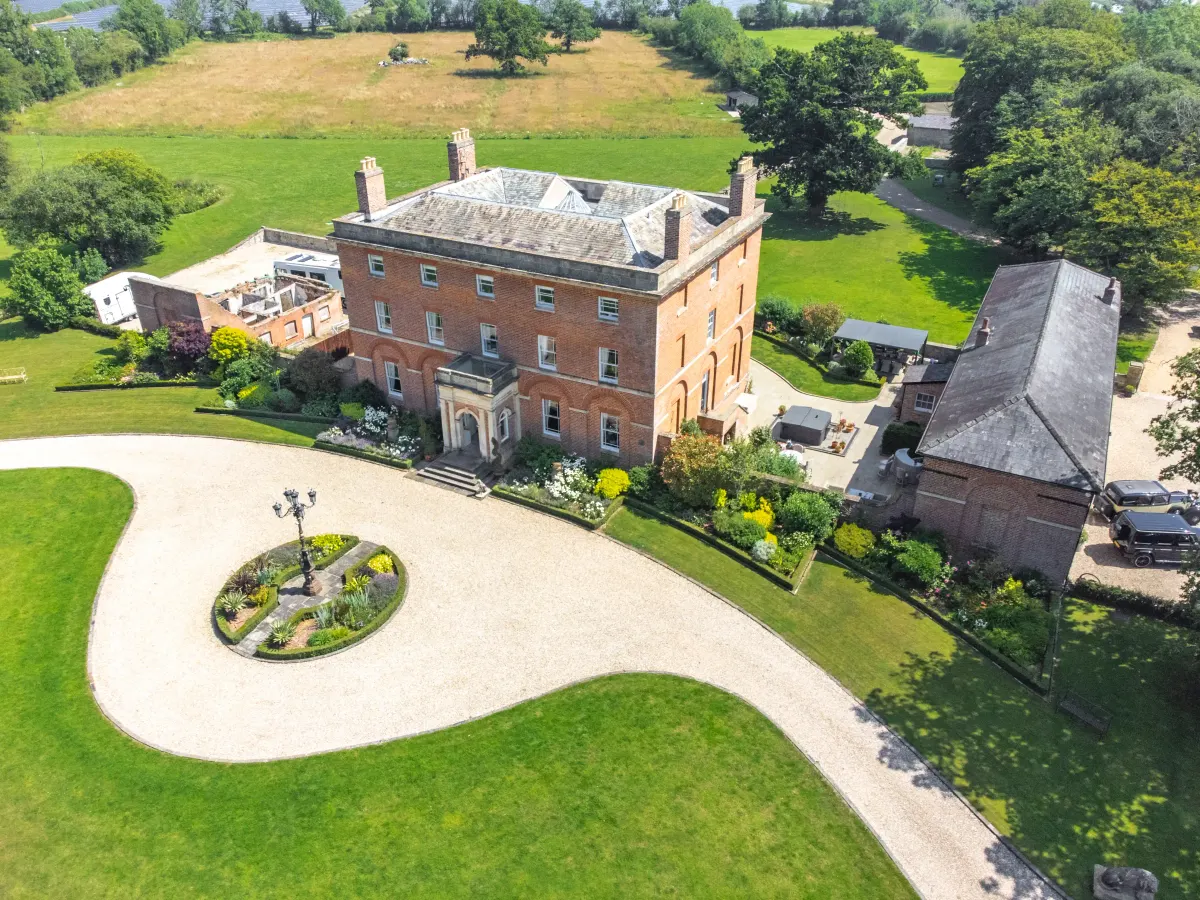
On the flat, reen-crossed farmland of the Gwent Levels, a few miles outside Newport, stands a Georgian country house that once echoed with the roar of lions. For a generation of Newport children growing up in the 1960s and 1970s, Whitson Court was simply "the zoo": a place of Sunday school outings, exotic birds and bears, presided over by a remarkable woman named Olive Maybury.
A House with a History
Long before any animals arrived, Whitson Court had a colourful past. A fine Welsh example of a neo-classical family home, it was almost finished by 1795, built for the Monmouthshire MP William Phillips, who also built Redbrick House (now Brick House Farm) in nearby Redwick. Local legend credits the design to the celebrated architect John Nash, though the dates make that doubtful.
Inscriptions in Whitson church show it was called Whitson House from at least 1789 and through most of the nineteenth century, becoming Whitson Court by 1903. A postcard of the house survives from around 1910.
After the death of St John Knox Richards Phillips in the early twentieth century, the house found an unexpected new life as a convent. An order of French nuns, the Sacramentines of Bernay, settled there at the invitation of the owner, the Rev. Oliver Rodie Vassall-Phillips, having fled religious persecution in France. The 1921 census records two priests and ten nuns in residence, most of them French. By around 1932 the community appears to have left for the United States.
In 1933 the house and its remaining 18 acres of gardens and parkland were bought from the then owner, Squire Oakley, by Mr Garroway Smith of "The Chalet" at Ridgeway, Newport. He moved in with his wife Mary and his sister Louise. His niece Olive, her husband William Maybury and their daughters Jane and Elizabeth also came to live at Whitson Court. Accounts differ on exactly when, but some place the Mayburys' arrival in 1938, the year their third daughter, Mary, was born there. A family photograph from around 1940 shows the Mayburys at the house, with Olive standing on the far right.
During the Second World War, Whitson Court became a place of refuge once more, this time for Jewish refugees escaping Nazi-occupied Europe. Later it provided work for German prisoners of war. Ironically, the house was also said to serve as a landmark for German bombers heading for Newport Docks.
How the Zoo Began
When Garroway Smith died in the late 1950s, the estate passed to Olive Maybury. She left her own mark on the house, adding three neo-classical plaster relief panels to the fireplace in the Morning Room and an ornately carved fire surround in the old kitchen. She also replaced a dilapidated spiral staircase to the top floor with a Gothic staircase salvaged from Plas Llecha at Tredunnock.
By then the grounds were already popular with local groups for Sunday school picnics and fetes, and the zoo grew almost by accident.
According to the family's own account, it started with two Himalayan bear cubs that had been used as an advertising gimmick by the Newport department store Reynolds. Mrs Maybury took them in, thinking they would delight the visiting children. A slightly different version, recalled by former keeper Margaret Gutteridge, has the bears rescued from a Newport pet shop window after members of the public protested at their treatment. Either way, they were the beginning of something much bigger.
Over the following years the collection expanded to include sun bears, a lion and three lionesses, monkeys, an aquarium, a reptile house and a large range of exotic birds, including flamingos and a free-flying group of macaws. Whitson Zoo opened to the public in 1965 and, through the late 1960s and 1970s, became a well-loved local attraction for families and school parties.
Jason, the Lion Nobody Wanted
The zoo's most famous resident was probably Jason the lion. Margaret Gutteridge, a Goldcliff woman who was delivering bread around Goldcliff, Whitson and Nash when she first came across the zoo, recalled that the cub came from a children's home in Chester that could no longer keep him. Mrs Maybury agreed to take him, and he arrived at Whitson in the children's minibus.
Margaret learned to bottle-feed the cub and remembered his particular fondness for ice cream. She went on to care for many of the zoo's other animals, including a mischievous goat that once climbed into a workman's van and refused to leave the driver's seat.
A Zoo in a Farming Community
Whitson Zoo sat in the middle of a working farming landscape, and its neighbours remember it fondly. Kath Johnson, who grew up on a farm in Goldcliff, recalled lying in bed listening to the lions roaring at night. She remembered Mrs Maybury as a kind woman, and said that when an animal died on her family's farm it would be passed on to feed the lions, a very practical arrangement between farm and zoo.
Others remember rushing from school on the bus to help with the evening feed, finding the keeper loading a trolley with buckets of maize, seed, fruit and meat. Mrs Maybury is remembered as a storyteller with a wealth of tales from her own adventurous life, and as an inspiration to the young people who helped out.
Not every memory is rose-tinted. By most accounts the zoo was not particularly well managed towards the end, and some former visitors describe it in its later years as run down and poorly attended, with Mrs Maybury struggling to keep it going. One recalled that she even rang his mother to ask whether he might take on the lion, as she could no longer look after him.
Closure
By the start of the 1980s, tighter licensing rules for zoos and changing public attitudes towards keeping wild animals had made the zoo's future untenable. Whitson Zoo closed in 1980, after fifteen years open to the public, with the family's stated intention being to let the remaining animals live out their lives in peace.
Many of the animals were rehomed, and Jason the lion went on to join the lions at Longleat. The Himalayan bears were less fortunate: no new home could be found for them, and they were put to sleep, their bodies reportedly sold to a taxidermist in Dolgellau.
Olive Maybury remained at Whitson Court for the rest of her life. She died on 20 September 1997, at the age of 98 or 99 (accounts differ).
Whitson Court Today
After her death the house stood empty for several years and was placed on Newport City Council's Buildings at Risk register. In 2007 the Grade II* listed building was bought by Collingbourne Properties, which carried out a major restoration between 2007 and 2010 to turn it back into a family home. The work included a full refurbishment, a new indoor swimming pool, offices, garaging, and the conversion of the old stables and staff quarters.
The restored house has since found a new audience on screen, appearing in the 2025 BBC drama The Guest, starring Eve Myles.
Today there is little to show that lions, bears and flamingos once lived here. But for those who grew up in Newport and on the Levels, Whitson Zoo lives on in memory: a slightly eccentric, very local zoo, born from a kindly woman's habit of taking in animals that nobody else wanted.